

There are spaces that seem to breathe easily and others that, even when well decorated, convey a sense of heaviness. It is not always related to the size of the room or the amount of furniture, but rather to the way in which all the elements articulate with each other. Visual lightness is created through subtle decisions, where proportion, materials, light e organisation work together to create more environments claros, balanced e pleasant to live.
At a time when interior design is approached with greater intention, knowing how to bring lightness to a space has become essential. It is not about radical minimalism, but rather about to organise better, choose com criterion and allow each element to contribute to a set coherent e fluid.
What is visual lightness?
Visual lightness refers to the way a space is perceived in a way balanced, fluids e without excess. A light environment does not depend on the number of pieces, but on how furniture, lighting, materials, and organisation come together, creating a sense of clarity e comfort.
A space with visual lightness presents a reading simple, without unnecessary interruptions. The eye moves around the room with ease, encountering no visual blockages or excessive clutter. It is this fluidity that makes the environment more comfortable e functional in everyday life.

Jacob TV Unit | L'oiseau | Shitake Coffee Tables | To-Tie Table Lamp | Bellhop Battery Table Lamp | Trino Side Table
How to reduce the visual weight of a space
The feeling of a heavy space often arises from accumulation and lack of hierarchy between the elements. To create visual lightness, we must start by simplifying, but above all by reorganising with intention.
Reducing excess does not mean removing identity, but eliminating what no add value. Overfilled surfaces, scattered objects, or redundant furniture hinder the perception of the space and create a feeling of clutter. By freeing up these areas, the environment gains clarity and becomes lighter.
The way the elements are arranged is also crucial. Group objects, create alignments and leave empty areas allows for better structuring of the division. An organised space always conveys greater visual lightness, even when incorporating different pieces.

Elysees Bed | Jannet Stool | Bedside Table 010 | Hebe Table Lamps
The importance of furniture for a light environment
O furniture It plays a central role in how a space is perceived. Volumes that are too heavy or concentrated can make the room feel denser, while a balanced choice contributes to greater fluidity.
Pieces raised off the floor help create visual continuity and make the space feel lighter. The eye moves through the room without interruption, which enhances the sense of spaciousness. The combination of more solid furniture e parts visually soups also contributes to the balance.
Shelves open, display cabinets or parts with lighter structure they can soften the presence of more compact furniture, preventing the space from becoming visually heavy. The variation in heights is equally important, allowing for better distribution of visual weight and creating dynamism in the composition.

Antony Modular Shelf | Jozeef Sofa | Akua armchair | Shitake Coffee Tables | Snoopy Table Lamp
Materials and light in the creation of light spaces
Materials directly influence the perception of lightness in a space. Natural materials, such as the wood, add depth and comfort, while elements such as the glass or metal structures Thin ones help to reduce the visual impact of the pieces.
Glass is particularly effective in creating visual lightness. It allows light to pass through, removes barriers, and contributes to a sense of continuity. When combined with more solid materials, it helps to balance the whole without diminishing its presence.
A lighting reinforces this perception. A natural light It should be valued whenever possible, avoiding obstructions and allowing it to be distributed evenly. Artificial lighting should be considered at different points, creating depth and avoiding areas that are too dark. A space well lit is, by definition, more level and more comfortable.
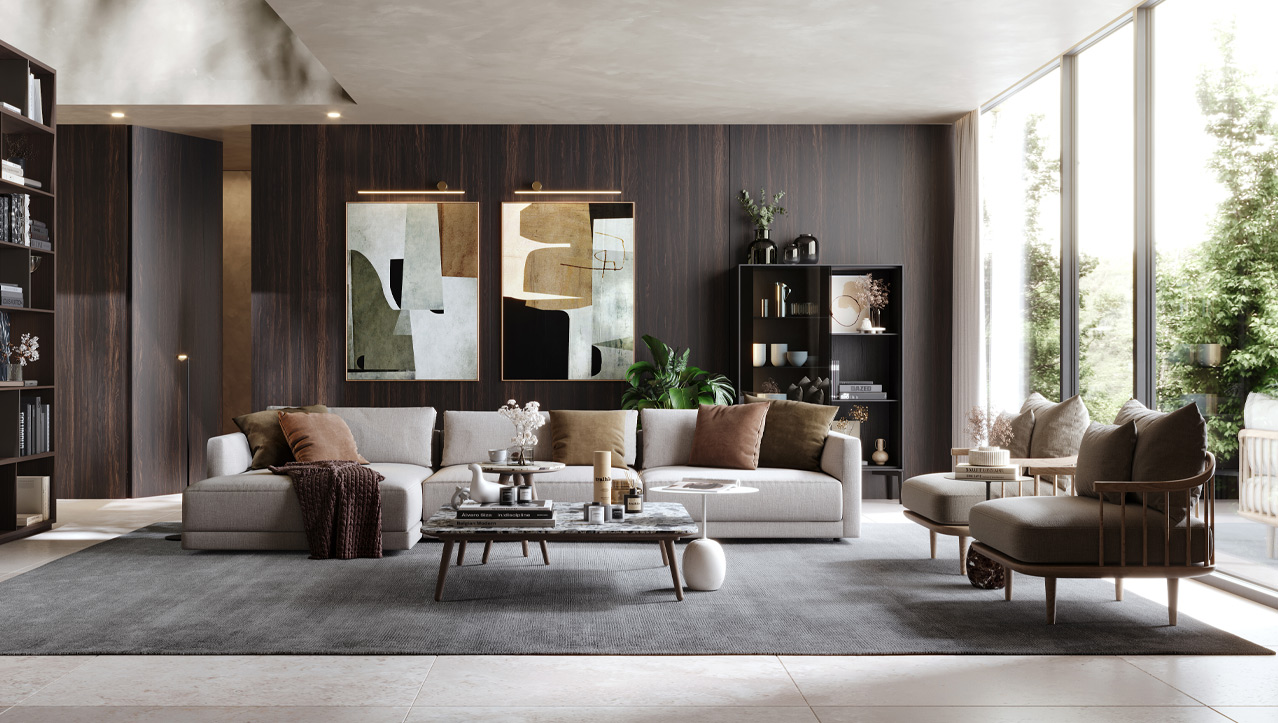
Jozeef Sofa | Seacoast Coffee Table | Lato LN9 Side Table | Vitrine Boxx 120150 Wooden Feet | Fly SC10 Armchair
Organisation and visual continuity
The visual lightness also depends on the coherence among the elements that make up the space. When there are too many variations of materials, colours or shapes, the division loses fluidity and becomes fragmented.
Maintain a consistent language allows to create continuity and reinforce the feeling of balance. The organisation of the home plays an essential role here. Items such as shelves, display cabinets, and cupboards help to structure the space and reduce visual clutter, provided they are used judiciously.
A well-organised shelf, with a balance between objects and open spaces, contributes to a lighter room. A closed cabinet allows you to hide the essentials, while a display case helps to showcase only what makes sense to keep visible. The goal is not to eliminate elements, but to ensure that everything has its place.

Gatto Table Lamp | Kutxa Console | Bean Mirror | Lantern Diffuser | Muses Vase
How to create visual lightness in practice
Giving a space a sense of visual lightness involves several factors fundamental decisions. Reducing excess, organising with intention, choosing suitable furniture, working well with materials, and enhancing the light are essential steps to transform the perception of a room.
More than just a trend in interior design, the visual lightness it translates into a more conscious way of living in the home. A light space it's more of course, but functional and more balancedIt is a space where everything seems to be in the right place, effortlessly, and where organisation and aesthetics coexist naturally.
At Tralhão each piece is designed to respond to this balance, combining functionality, proportion e materials that contribute to more environments claros all right structured. Because, in the end, the way furniture is chosen and arranged defines not only the space but also how it is used. experienced in everyday life.
For more information, contact us on 239 506 400 or by email at